

Anatolii Shevchenko
Professor Anatolii Shevchenko graduated from the Faculty of Physics at Donetsk State University with a major in Radio Physics and Electronics. In 1985, he defended his Ph.D. thesis, earning the academic degree of a candidate. In 1990, he completed his doctoral thesis, obtaining the academic degree of Doctor of Technical Sciences. In 1997, he was awarded the title of professor, and in 1998, he received the honorary title of Honored Scientist and Technician of Ukraine. In 2006, Anatolii Shevchenko was elected as a Corresponding Member of the National Academy of Sciences of Ukraine in the field of Computer Systems. In 2015, he was appointed as the Director of the Institute of Artificial Intelligence of the Ministry of Education and Science of Ukraine and the National Academy of Sciences of Ukraine in Kyiv. Together with the Department of Informatics of the National Academy of Sciences of Ukraine, he initiated an international scientific journal called ‘Artificial Intelligence’ and was appointed as its chief editor. His research interests encompass various aspects of artificial intelligence, modeling human intelligence, simulating elements of human consciousness, breakthrough technologies in the field of artificial intelligence, and multidisciplinary aspects of artificial intelligence.
He currently serves as the Director of the Institute of Artificial Intelligence Problems of the Ministry of Education and Science of Ukraine and the National Academy of Sciences of Ukraine. As Director, he oversees ongoing scientific projects aimed at researching and developing cutting-edge software systems applied in various fields, including medicine, defense, and others. Today, under his leadership, the institute remains at the forefront of scientists and specialists in one of the most promising and pivotal fields for humanity – informatics and artificial intelligence.
He has a spectacular scientific record, having authored 215 scientific publications and monographs, 13 patented inventions and 15 educational and methodological manuals for schools and higher education institutions. His scientific works, such as ‘;Current Issues in Artificial Intelligence Theory’ (monograph), ‘Multimedia Mathematics’ (educational manual), and ‘Informatics in Ukraine’ (educational manual), encompass fundamental and applied advancements in the fields of cybernetics, informatics, and artificial intelligence.

Tetiana Yeroshenko-Shevchenko
Tetiana Yeroshenko (31.01.1971) obtained her Ph.D. degree in 2016 in the field of «Philosophy of Science» from the H.S. Skovoroda Institute of Philosophy (Kyiv, Ukraine). She is a research scientist at the Department of Theoretical Research in the field of artificial intelligence at the Institute of Artificial Intelligence of the Ministry of Education and Science of Ukraine and the National Academy of Sciences of Ukraine (Kyiv). Has been working at the Institute of Artificial Intelligence Problems since 1994. Her research interests include the philosophy of science and multidisciplinary aspects of artificial intelligence.
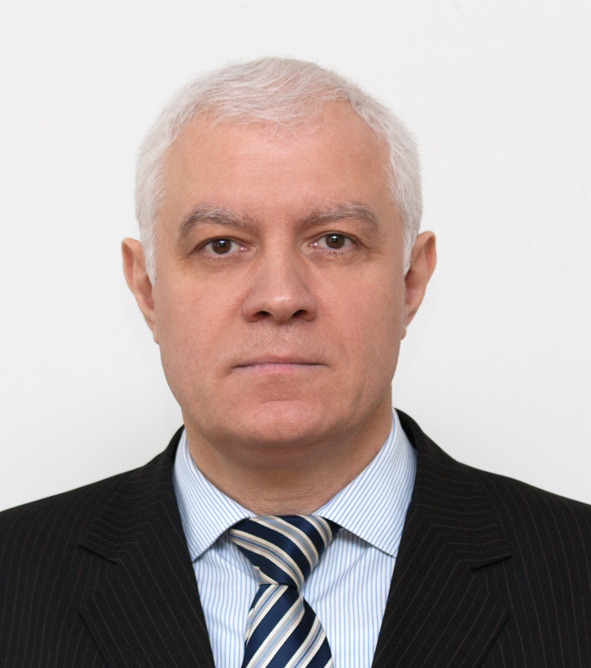
Vadym Slyusar
Vadym Slyusar is a Doctor of Sciences, Professor, and Honored Worker of Science and Technology of Ukraine (2008). He received his Candidate of Sciences degree in 1992, his Doctor of Sciences degree in 2000, and was awarded the academic title of Professor in the specialty “Military Cybernetics, Control Systems, and Communications” (2005). Prof. Slyusar is the author of over 1,050 publications, including 72 copyright certificates and patents. As a scientific advisor and supervisor, he has guided 16 Candidates of Sciences, 1 PhD and 2 Doctors of Sciences, cultivating the next generation of researchers in critical technological domains.
An innovative and forward-thinking researcher with extensive experience in artificial intelligence (AI), quantum systems, and radio frequency engineering. Recognized as a pioneer of concepts N-OFDM (1992), UAV swarm-based air defense systems (2017), and multi-agent LLM architectures for robotic platforms. He introduced novel matrix operations that are now widely applied in AI and statistical data processing. His contributions have led to new research directions in data transmission, as well as technological advancements in both hardware and software, including augmented and mixed reality systems. He demonstrated the ability to identify emerging trends ahead of their time and transform abstract concepts into implementable and efficient solutions.

Roman Malyi
Roman Malyi is a software engineer and researcher specializing in artificial intelligence, full-stack development, and software engineering. He combines academic and industrial experience, serving in research roles at the Institute of Artificial Intelligence Problems of Ukraine, and full-stack engineering work in industry. This combination gives him a strong profile for projects that require both technical execution and research depth. He has contributed to applied research on AI-powered psychological assistants, including a 2024 co-authored study on a virtual psychological assistant for the healthcare sector. That work focused on chatbot-based psychological support and incorporated methods such as LLMs, semantic analysis, RAG, and deep-learning fine-tuning, alongside attention to privacy, ethics, and accessibility. His recent research also includes LLM-supported software architecture and schema-evolution problems, including work on event-schema evolution. Overall, his profile reflects a strong combination of scientific thinking, AI product development, and modern software engineering practice.

Mykyta Klymenko
Mykyta Klymenko is a postgraduate researcher in Computer Science at the State University of Information and Communication Technologies, specializing in artificial intelligence, data analysis, and intelligent information systems. He has 11 years of research experience in the field of AI, with a focus on natural language processing, behavioral data analysis, predictive modeling, and the development of applied AI systems. His scientific work related to autonomous systems, decision support, and defense-oriented technologies. He began research activity at the Institute of Problems of Artificial Intelligence of the Ministry of Education and Science of Ukraine and the National Academy of Sciences of Ukraine. Since 2026, he has been serving as Acting Head of the Research Department at the State University of Information and Communication Technologies. Publication record includes articles in peer-reviewed journals and international conference proceedings, including works published by Oxford University Press and in IEEE conferences such as CSIT and ACIT.
Anatolii Shevchenko
Professor Anatolii Shevchenko graduated from the Faculty of Physics at Donetsk State University with a major in Radio Physics and Electronics. In 1985, he defended his Ph.D. thesis, earning the academic degree of a candidate. In 1990, he completed his doctoral thesis, obtaining the academic degree of Doctor of Technical Sciences. In 1997, he was awarded the title of professor, and in 1998, he received the honorary title of Honored Scientist and Technician of Ukraine. In 2006, Anatolii Shevchenko was elected as a Corresponding Member of the National Academy of Sciences of Ukraine in the field of Computer Systems. In 2015, he was appointed as the Director of the Institute of Artificial Intelligence of the Ministry of Education and Science of Ukraine and the National Academy of Sciences of Ukraine in Kyiv. Together with the Department of Informatics of the National Academy of Sciences of Ukraine, he initiated an international scientific journal called ‘Artificial Intelligence’ and was appointed as its chief editor. His research interests encompass various aspects of artificial intelligence, modeling human intelligence, simulating elements of human consciousness, breakthrough technologies in the field of artificial intelligence, and multidisciplinary aspects of artificial intelligence.
He currently serves as the Director of the Institute of Artificial Intelligence Problems of the Ministry of Education and Science of Ukraine and the National Academy of Sciences of Ukraine. As Director, he oversees ongoing scientific projects aimed at researching and developing cutting-edge software systems applied in various fields, including medicine, defense, and others. Today, under his leadership, the institute remains at the forefront of scientists and specialists in one of the most promising and pivotal fields for humanity – informatics and artificial intelligence.
He has a spectacular scientific record, having authored 215 scientific publications and monographs, 13 patented inventions and 15 educational and methodological manuals for schools and higher education institutions. His scientific works, such as ‘;Current Issues in Artificial Intelligence Theory’ (monograph), ‘Multimedia Mathematics’ (educational manual), and ‘Informatics in Ukraine’ (educational manual), encompass fundamental and applied advancements in the fields of cybernetics, informatics, and artificial intelligence.
Tetiana Yeroshenko-Shevchenko
Tetiana Yeroshenko (31.01.1971) obtained her Ph.D. degree in 2016 in the field of «Philosophy of Science» from the H.S. Skovoroda Institute of Philosophy (Kyiv, Ukraine). She is a research scientist at the Department of Theoretical Research in the field of artificial intelligence at the Institute of Artificial Intelligence of the Ministry of Education and Science of Ukraine and the National Academy of Sciences of Ukraine (Kyiv). Has been working at the Institute of Artificial Intelligence Problems since 1994. Her research interests include the philosophy of science and multidisciplinary aspects of artificial intelligence.
Vadym Slyusar
Vadym Slyusar is a Doctor of Sciences, Professor, and Honored Worker of Science and Technology of Ukraine (2008). He received his Candidate of Sciences degree in 1992, his Doctor of Sciences degree in 2000, and was awarded the academic title of Professor in the specialty “Military Cybernetics, Control Systems, and Communications” (2005). Prof. Slyusar is the author of over 1,050 publications, including 72 copyright certificates and patents. As a scientific advisor and supervisor, he has guided 16 Candidates of Sciences, 1 PhD and 2 Doctors of Sciences, cultivating the next generation of researchers in critical technological domains.
An innovative and forward-thinking researcher with extensive experience in artificial intelligence (AI), quantum systems, and radio frequency engineering. Recognized as a pioneer of concepts N-OFDM (1992), UAV swarm-based air defense systems (2017), and multi-agent LLM architectures for robotic platforms. He introduced novel matrix operations that are now widely applied in AI and statistical data processing. His contributions have led to new research directions in data transmission, as well as technological advancements in both hardware and software, including augmented and mixed reality systems. He demonstrated the ability to identify emerging trends ahead of their time and transform abstract concepts into implementable and efficient solutions.
Roman Malyi
Roman Malyi is a software engineer and researcher specializing in artificial intelligence, full-stack development, and software engineering. He combines academic and industrial experience, serving in research roles at the Institute of Artificial Intelligence Problems of Ukraine, and full-stack engineering work in industry. This combination gives him a strong profile for projects that require both technical execution and research depth. He has contributed to applied research on AI-powered psychological assistants, including a 2024 co-authored study on a virtual psychological assistant for the healthcare sector. That work focused on chatbot-based psychological support and incorporated methods such as LLMs, semantic analysis, RAG, and deep-learning fine-tuning, alongside attention to privacy, ethics, and accessibility. His recent research also includes LLM-supported software architecture and schema-evolution problems, including work on event-schema evolution. Overall, his profile reflects a strong combination of scientific thinking, AI product development, and modern software engineering practice.
Mykyta Klymenko
Mykyta Klymenko is a postgraduate researcher in Computer Science at the State University of Information and Communication Technologies, specializing in artificial intelligence, data analysis, and intelligent information systems. He has 11 years of research experience in the field of AI, with a focus on natural language processing, behavioral data analysis, predictive modeling, and the development of applied AI systems. His scientific work related to autonomous systems, decision support, and defense-oriented technologies. He began research activity at the Institute of Problems of Artificial Intelligence of the Ministry of Education and Science of Ukraine and the National Academy of Sciences of Ukraine. Since 2026, he has been serving as Acting Head of the Research Department at the State University of Information and Communication Technologies. Publication record includes articles in peer-reviewed journals and international conference proceedings, including works published by Oxford University Press and in IEEE conferences such as CSIT and ACIT.